Widespread adoption of artificial intelligence (AI) and big data technologies has driven transformative change across virtually every industry, changing how organisations generate strategic insights and drive data-driven decision-making.
This rapid rate of adoption isn’t expected to slow down anytime soon. According to Grand View Research, the global market for AI technology is projected to grow at an annual rate of 36.6%, reaching a total global market value of more than $1.8 trillion by 2030.
From small businesses to enterprise corporations, AI and big data are bringing new efficiencies and capabilities to strategy development and day-to-day operations. As a global storage leader, Seagate plays a central role in providing the scalable, reliable, and high-performance data storage systems that businesses need to support AI and big data in their workflows.
What is AI?
Artificial intelligence is an innovative technology capable of performing reasoning, learning, and problem-solving with logical capabilities that simulate human cognition and intelligence.
AI is an umbrella term encompassing many forms of virtual intelligence, including machine learning, generative AI and natural language processing. Through advanced algorithms, big data and prompt engineering, AI is a revolutionary tool powering new capabilities regarding personalisation and automation.
What is big data?
Big data refers to high-volume datasets that are so large and complex they require specialised systems to process, manage and analyse its information. Big data typically represents datasets coming from a wide range of sources, and the data is unified by its ownership by, or relevance to, a specific organisation or entity.
AI, machine learning, and advanced analytics are typically required to effectively process and analyse big data to generate valuable insights from this information.
Types of data used in AI
AI can use several types of data to generate valuable insights that offer strategic value to businesses seeking to elevate performance, optimise productivity, and enable continuous improvement across its teams and operations.
Here are the three types of data everyone should know when using AI for data analytics:
1. Structured data
Structured data is processed, organised data that’s easily searchable within a database. Common sources of structured data include customer information, inventory data, transactions and maintenance logs.
This type of data is the most suitable to deliver strategic insights that guide optimizations and other changes within an organisation.
2. Unstructured data
Unstructured data is information that needs to be processed before meaning and insights can be derived from it. Images, video, and certain kinds of text files are common forms of unstructured data.
AI technologies have become an effective tool for analysing this data at scale, allowing businesses to extract powerful insights from unstructured datasets. For example, AI can monitor security footage and identify anomalies indicating specific behaviour. It can also help evaluate customer feedback to automatically contextualize and categorise each individual response.
3. Big data
Big data typically includes both structured and unstructured datasets, all of which must be processed and managed at scale. AI can move across structured and unstructured data to identify patterns in customer behaviour. It can also coordinate relationships between structured data trends and unstructured data events to help contextualize information about changes in operations, shopping patterns, supply chain logistics and many other applications.
Connection between AI and big data
As AI technologies are used to process and analyse big data, these two separate entities enjoy mutual benefits from this ongoing relationship.
Big data analysis gives AI models more information to learn and refine their models, improving AI performance over time. Meanwhile, better AI analytic capabilities increase the potential business impact of insights gleaned from big data, delivering more value to your organisation.
This symbiotic relationship allows many industries to achieve rapid insight processing that supports data-driven interventions and personalised AI solutions.
How AI drives exponential data growth
Through the consumption and analysis of data, AI itself has become a significant source of data growth through machine learning, automation and content automation. IoT devices and other AI- enhanced technology all contribute to unprecedented volumes of real-time data that must be managed, analysed and stored.
Managing data on this scale requires robust, high-performance storage infrastructure that can meet your current and future storage needs.
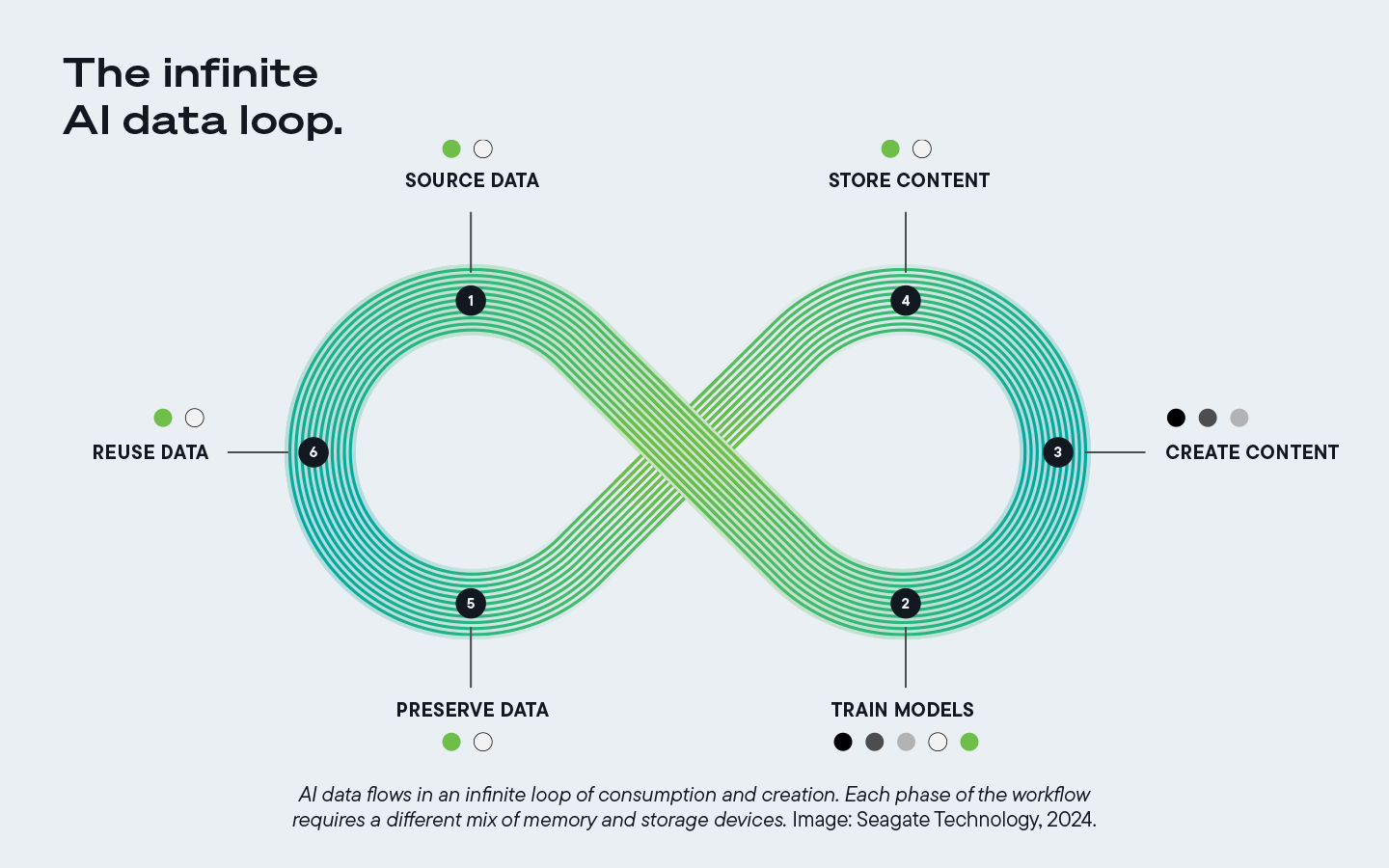
Understanding data flow in the AI process
AI data analysis relies on a continuous lifecycle that supports ongoing learning and refinement for your AI models. Here’s how AI and big data work together to support ongoing creation and iteration:
1. Data collection
AI must have access to diverse, high-quality data sources, including IoT sensors, business software integrations, direct interactions with customers, and a proprietary knowledge base. This information and its access must be effectively managed to ensure data is complete and accurate, and that the data collection process is adhering to privacy and other compliance requirements.
2. Data preparation and cleaning
Data preparation and cleaning eliminates anomalies and inaccuracies that undercut the value of those datasets. Common techniques used in this phase of the data flow include deduplication and normalization, among other tactics.
3. Data annotation and labelling
Annotation and labelling are critical when training AI models. Annotation tags data with relevant contextualizing information, such as labelling objects in videos and images, or applying sentiment labels to help the AI better comprehend customer feedback. Over time, consistent annotation and labelling will support better training and more effective AI outcomes.
4. Data storage and management
Efficient, highly scalable storage is required to support efficient data management and data storage for AI workflows. Businesses must build supportive infrastructure using solutions like Seagate Mozaic 3+™, which is designed specifically to serve the unique storage challenges of AI implementations.
5. AI data feedback loop
AI’s long-term value is based on iterative improvements. A sustainable AI data feedback loop involves a continuous cycle of data consumption, content generation, and performance improvement that all contribute to these iterative improvements. Organisations must have seamless data access for AI technologies to facilitate this virtuous cycle of development.
AI storage needs
Demanding AI workflows require a storage infrastructure that’s designed to balance the following requirements:
● High performance for rapid data processing. AI workflows need fast storage performance that offers low latency at scale, especially when using AI to generate real-time insights.
● Scalability to accommodate growing datasets. As data volume increases and AI implementations increase, storage infrastructure must grow seamlessly alongside these services.
● Reliability to secure uninterrupted workflows. Storage performance must be maintained even during peak periods of use and under the strain of growing datasets.
To meet these multifaceted needs, businesses need a diverse ecosystem of memory and storage solutions, utilising local and network solid-state drives (SSDs), high bandwidth memory (HBM), dynamic random-access memory (DRAM), and network hard drives.
Storage and compute synergy in AI
In an AI workflow, storage and compute clusters do not exist as separate entities. They have a synergistic role in the overall performance and optimisation of AI workflows. GPUs, CPUs, HBM, DRAM, enterprise SSDs, and enterprise hard drives each serve specific capabilities regarding processing power and data management. Seamless integration of these solutions is critical to maximising AI performance.
Seagate’s role in enabling AI and data management at scale
Seagate offers a suite of enterprise storage solutions that optimise capacity and efficiency in your data centre, supporting buildout while future-proofing your infrastructure for evolving AI demands and a growing volume of AI workflows. With Mozaic 3+, your business can equip its data centre with mass-capacity storage at unprecedented areal densities.
Storage and compute — tandem needs for AI workflows
The Seagate Mozaic 3+ solution effortlessly supports the complementary technologies comprising your AI workflow, raising the ceiling for performance, scalability and reliability.
A synergistic approach to managing computing resources and storage ultimately optimises the speed, efficiency, energy consumption, and availability of your AI capabilities. When properly implemented, these solutions span the spectrum between performance and scale to maximise the long-term value realisation of your AI investments.
Learn how Mozaic 3+ helps AI reach its full potential
The transformative power of AI requires storage infrastructure that breaks barriers and raises storage density and performance to new heights.
Seagate Mozaic 3+ solutions, including Exos® Mozaic 3+ hard drives, achieve this via heat-assisted magnetic recording (HAMR), which enables significant areal density gains that pack data tighter into a smaller, more efficient space — while keeping that data magnetically and thermally steady.
With HAMR, Mozaic 3+ expands the limits of storage density without compromising reliability for that storage — and while still fitting that convenient, familiar 3.5-inch form factor.
Conventional storage infrastructures aren’t equipped to support the rapid growth of AI workflows and big data initiatives. Businesses that want to take advantage of these innovative opportunities must first ensure that they’ve built a storage foundation capable of supporting these initiatives at scale.
Explore Seagate storage solutions for yourself — and discover how Mozaic 3+ can help address your emerging AI and big data needs.




.png/_jcr_content/renditions/4-3-small-416x312.png)






-v4.png/_jcr_content/renditions/4-3-medium-688x516.png)