Hard drives are the most sustainable data storage medium
Sustainability isn’t just about how efficiently a product performs during its use. It’s about its entire lifecycle — from raw materials to end of life. While focusing on operational life is important, data center operators also care about environmental impacts that occur due to production, transportation and disposal.
These lifecycle stages contribute to Scope 1, 2, 3 and 4 emissions: direct emissions from owned operations (Scope 1), indirect emissions from purchased energy (Scope 2), all other indirect emissions across the value chain (Scope 3) and “avoided emissions” (Scope 4), meaning emissions that are avoided when a company’s products or services help others reduce their footprint. By taking a full lifecycle perspective, we can design more intelligently, source more responsibly and reduce emissions at every stage.
Storage racks alone account for 24% of operational and 45% of embodied emissions in general-purpose cloud data centers, according to HotCarbon's research¹. Storage servers carry so many storage devices they become the dominant energy consumers.
The best way to reduce operational emissions in a storage server is to reduce the storage devices’ energy. Hard drive storage racks use 4 times less power and have 10 times less embodied carbon emissions compared to SSD storage racks.
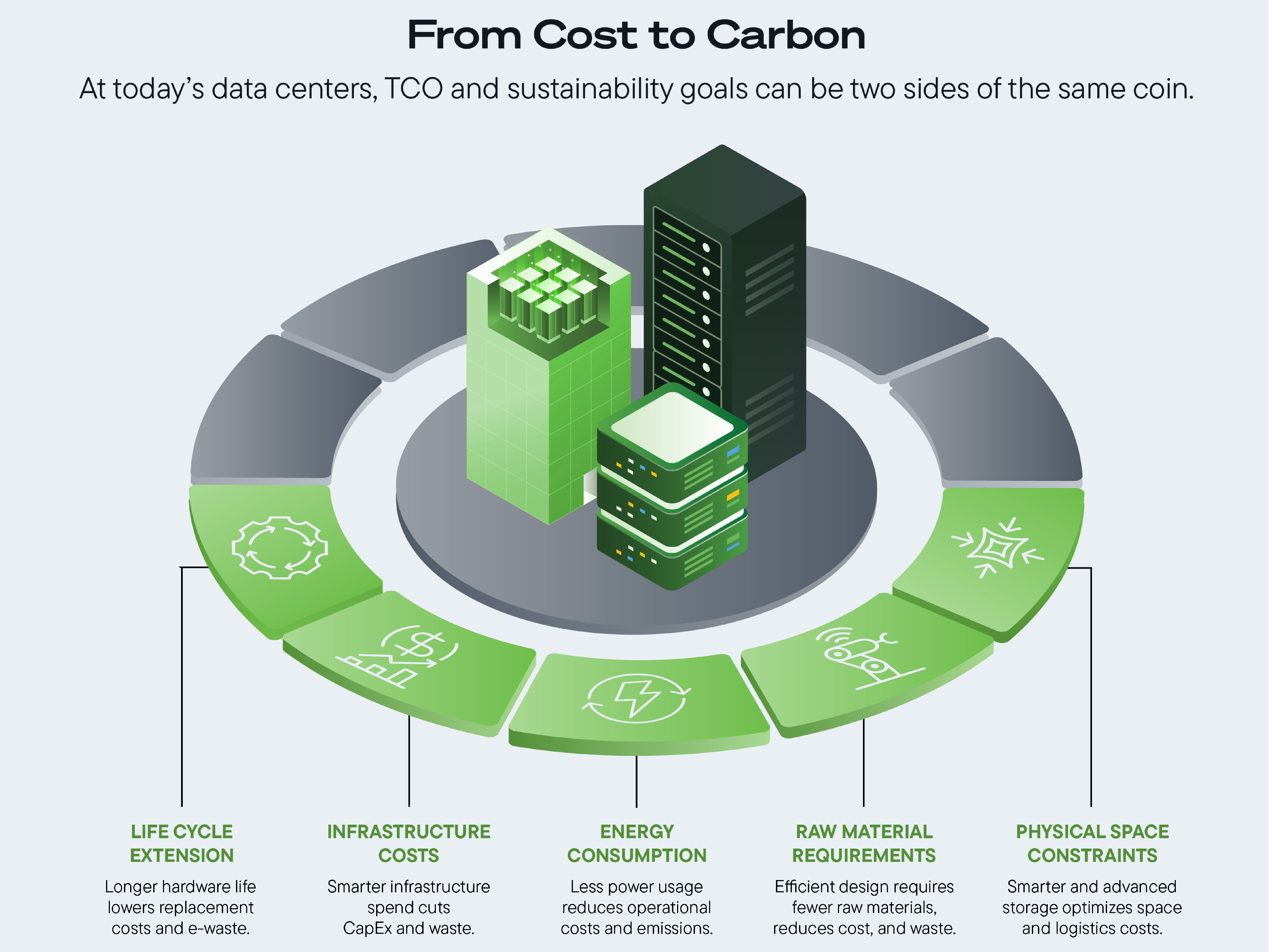
Investments in higher areal density hard drives allow cloud service providers to store more data per drive, allowing more capacity to be deployed within the same physical footprint. This lowers the total cost of ownership by cutting hardware, energy and space costs, and advances sustainability efforts by decreasing raw material usage and electronic waste. In this way, enhancements in storage efficiency simultaneously boost data center profitability and promote environmental responsibility. Sustainability and cost savings can go hand in hand.
Cloud services maximize the efficiency of both storage and compute resources. Hard drives offer the most sustainable data storage solution across the entire lifecycle compared to SSDs and tape.
Hard drives help address data center sustainability challenges
<0.27 kg | 1×
5.9 kg | 20×
<0.6 kg | 3×
<0.22W | 1×
0.8W | 3×
1W | 5×
1×
6×
2-5×
1×
4× operational
10× embodied
Not publicly disclosed
22% kg CO₂e reduction per TB
30% improvement
0.22Watt/TB is a 55% power reduction per TB
120% improvement
2 times more capacity
100% improvement in slot utilization
It is crucial for industries to understand the environmental impact of their products. This white paper delves into the concepts of life cycle assessment and embodied carbon, offering a comprehensive analysis of their significance in evaluating and mitigating the environmental footprint of products — from creation to disposal.
Seagate Secure delivers robust data protection for the entire lifespan of your hard drive, utilizing hardware-based encryption and cryptographic erasure to prevent unauthorized access. With built-in SED and ISE features, your data remains secure from installation through end of life, promoting compliance with privacy and regulatory standards. Seagate Secure makes safe drive reuse, recycling and material recovery possible — supporting both data privacy and environmental goals within a circular business model.
Seagate's Circularity Program is designed to extend the life cycle of hard drives, offering a secure and sustainable alternative to the traditional “take-make-waste” model by prioritizing reuse over recycling. This approach significantly reduces electronic waste and carbon emissions. Studies show that reusing hard drives saves 275 times more CO₂ equivalent (CO₂e) compared to recycling the components — specifically, reuse can result in a reduction of 5.5 kg² CO₂e per drive, while recycling only achieves a reduction of 0.02 kg² CO₂e. With secure data sanitization and certified erasure, Seagate makes it possible for drives to be safely refurbished and redeployed, minimizing environmental impact and supporting a more responsible datasphere.
McAllister, S. et al. “A Call for Research on Storage Emissions” HotCarbon. July 9, 2024: https://hotcarbon.org/assets/2024/pdf/hotcarbon24-final126.pdf
Jin, H., Frost, K., Sousa, I., Ghaderi, H., Bevan, A., Zakotnik, M. and Handwerker, C., 2020. Life cycle assessment of emerging technologies on value recovery from Hard Drives. Resources, Conservation and Recycling, 157, p.104781. https://doi.org/10.1016/j.resconrec.2020.104781
Ocient/Soligidm Whitepaper 2025: Meeting the Challenges of Modern Big Data Solidigm D5-P5430 (30.72TB): 900 kg CO2e / 30.72TB = 29.3 kg CO2e/TB / 5 years = 5.86 kg CO2e/TB/Year
Embodied carbon prediction for Seagate Exos Mozaic 40TB hard drives per TB for five-year life cycle.
“Breakdown of the CO2e and Other Positive Sustainability Impacts of IBM Physical Tape Products “ IBM LTO FH drive with 1 media. https://www.ibm.com/downloads/cas/YE5WAQ0B January, 2022. Spectra Logic LTO-10 Tape Drive Datasheet (LTO power consumption) https://spectralogic.com/wp-content/uploads/LTO-10-Tape-Drive-Datasheet-Spectra-Logic.pdf.
Using total embodied carbon per TB with a 5-year lifecycle.
Assumes hyperscaler use case with 24×7 operation and no idle time.
Seagate analysis of power consumption and carbon emissions for different archive workloads. Comparing LTO10 Tape with Mozaic 40TB hard drives and 30.72 TB SSD.