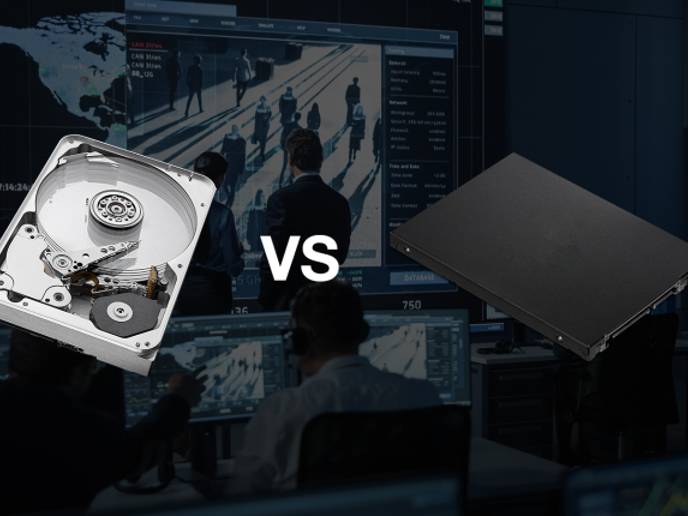
Key takeaways
- Hard drives are the path to sustainable and efficient data centers.
- They have lower embodied carbon and energy per terabyte (TB) at full-rack scope.
- Areal density and circularity reduce carbon per TB year and extend ROI.
As AI demand and energy costs rise, data center operators face constraints in power, cooling and space. Power grids are straining under new loads. The issue has entered policy debates. And sustainability is now part of capacity planning.
Regulators, customers and investors expect credible progress against climate goals. Driven by the need to keep more data available, storage demand keeps growing. The key question: Can additional capacity fit within sustainability goals and efficiency constraints?
Because architectures must deliver usable capacity over time without disproportionate rack-level and lifecycle emissions, sustainability shapes how storage is deployed at scale. In turn, storage choices affect how efficiently data centers use power and space.
High-capacity hard drives improve power-density efficiency by delivering more usable data per watt and per rack, and reducing the energy, cooling, and the footprint required to keep GPUs productive. As GPU power draw climbs, hard drive storage helps scale out data centers sustainably
To fully understand that sustainability impact, storage must be evaluated at the rack level rather than at device level. Storage architectures must be assessed across three dimensions:
- Embodied carbon per usable TB year
- Operational emissions (from total power per usable TB, which includes cooling and supporting infrastructure like enclosures, etc.)
- Lifecycle behavior (how long deployed capacity remains usable)
Evaluating these factors shows that hard drive–based architectures deliver the lowest total carbon footprint per usable TB over time.
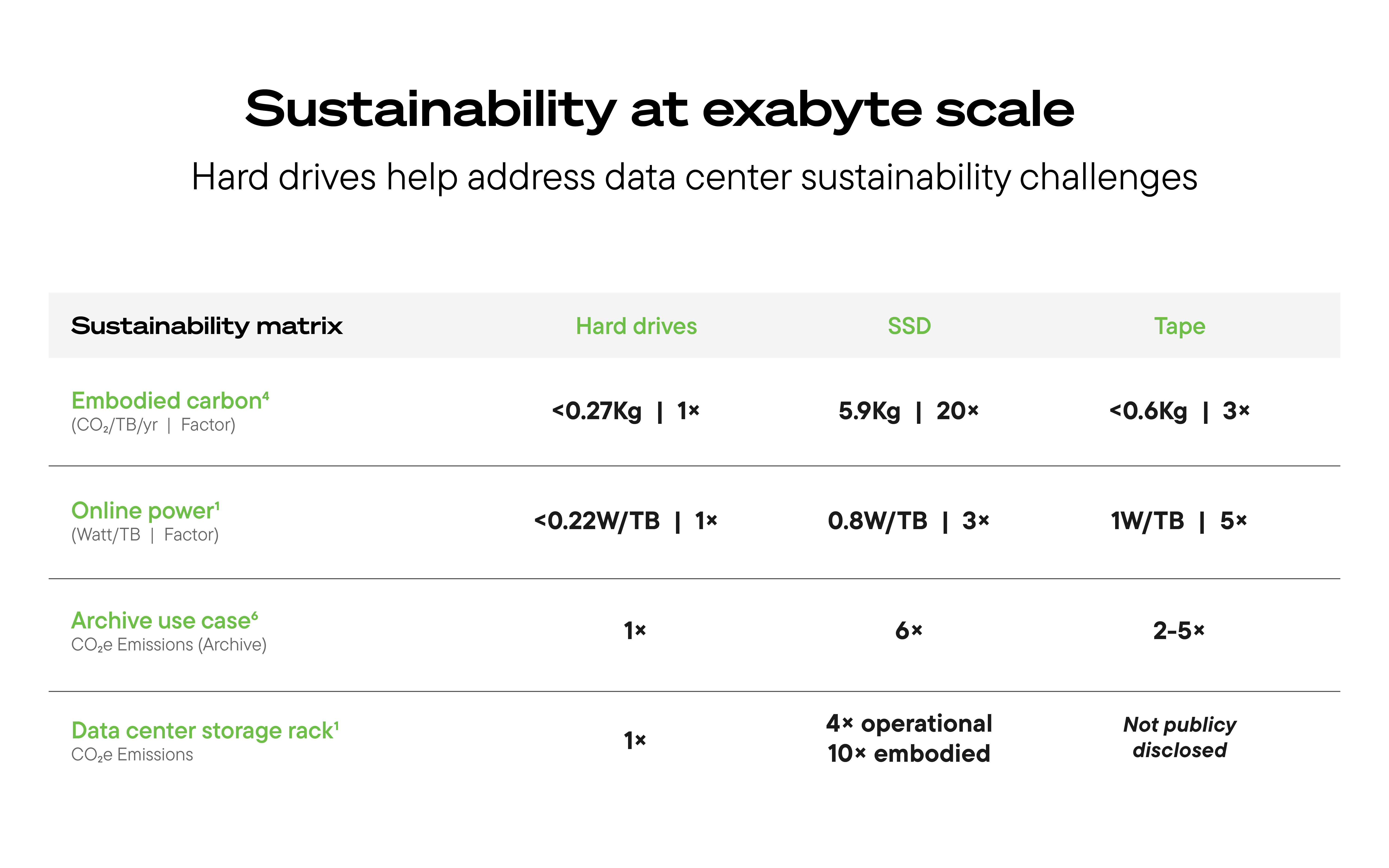
Before we take a closer look at these three dimensions, consider the benchmarks in the table below.
It compares embodied carbon, operational energy use and lifecycle efficiency per usable capacity at rack scale, with hard drives as the baseline.1, 4, 6
Embodied carbon per usable TB at rack scale
The first row of the table highlights embodied carbon — the emissions associated with building storage capacity — and shows how these impacts scale when evaluated per usable TB over time.
At rack scale, power delivery, cooling and physical constraints shape outcomes. Architectures that deliver more usable capacity per device and rack reduce the emissions tied to building and replacing capacity.
At equivalent usable capacity, rack-scale modeling shows capacity-dense, long-life hard drive–based architectures use about 4× less operational power and deliver about 10× lower embodied carbon than other device-based designs. The difference reflects how capacity is produced and maintained at scale, including manufacturing intensity and capacity overhead required for endurance.1
Solid-state drives (SSDs) can carry several times the embodied carbon per usable terabyte of hard drives, with modeled ranges spanning up to more than 20× the carbon, depending on capacity and deployment assumptions. SSD deployments also often require installing extra capacity (called “overprovisioning”) because operators avoid using full rated capacity under sustained write workloads to reduce premature wear out. That reduces usable capacity per deployed SSD and increases CO₂e per usable TB.7
Operational emissions at rack scale: Power and cooling
The online power row of the table focuses on the energy required to keep storage online, and the cooling and infrastructure needed to support it. It shows how power density and rack design influence total emissions at scale.
Operational emissions depend on online power per TB. In benchmarks reported by S. McAllister et al. at HotCarbon.org, online power assumes 24×7 hyperscaler operation to reflect always-on behavior at scale.1
The Seagate Mozaic® platform advances areal density and power management, reducing rack-level energy use. Seagate’s deployment-scale analysis shows Mozaic-class hard drives operate at ~0.22 watts per TB, using up to 70% less power than prior-generation architectures under defined assumptions. In modeled one-exabyte deployments, the latest Mozaic 4+ platform improves overall infrastructure efficiency by approximately 47% — compared to standard 30TB drives — reducing the required data center footprint by roughly 100 square feet and lowering annual energy consumption by about 0.8 million kilowatt-hours.4
McAllister et al. show that hard drive-based tiers can manage a large share of deployed data while contributing a smaller share of operational storage emissions. Higher rack power density increases cooling needs and supporting infrastructure, raising operational and embodied emissions.1
According to McAllister’s 2024 analysis: SSD racks hold just 13% of deployed cloud capacity, but account for 39% of operational storage emissions. Hard drives store 87% of cloud data but contribute 48% of operational emissions.1
Operational emissions capture the always-on cost. Total impact also depends on lifecycle: how long deployed capacity stays usable under real workloads.
Lifecycle realities: Why hard drives remain the default
Hard drives store most enterprise and cloud data because they scale efficiently and perform optimally over long service lives.
By comparison, flash storage systems, which are useful for data needing immediate access, require overprovisioning to manage write endurance under sustained workloads. That reduces usable capacity and increases cost and carbon per effective TB over a deployment.7
Hard drives’ longer usability improves lifecycle efficiency, which contributes to their significantly lower embodied carbon per TB per year: 0.27Kg for hard drives versus 5.9Kg for SSDs (see the table’s embodied carbon row). This is partly why they are the foundation for object storage, AI data pipelines and mass data retention.1, 4
Longer service life reduces replacement cycles and embodied emissions. Longevity depends on workload and system design. Energy-aware architectures enable redeployment, extend service life and reduce electronic waste.
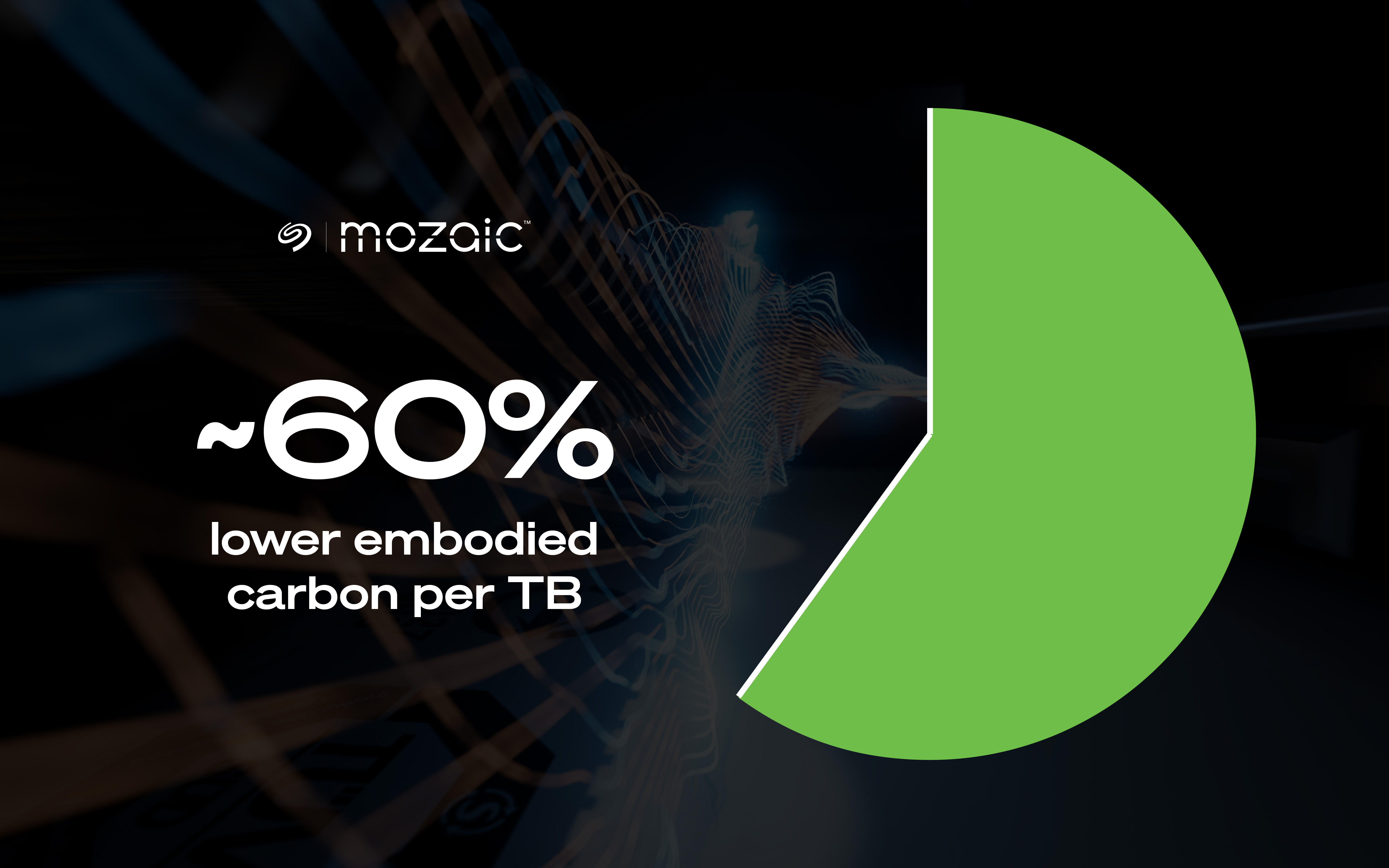
Seagate Mozaic hard drive technology delivers over 40TB per device with strong energy efficiency, enabling dense clusters within thermal and energy budgets. Under normalized lifecycle benchmarks, Mozaic-class hard drives deliver up to ~60% lower embodied carbon per TB than prior-generation platforms.4
Considering embodied carbon, operational energy use, and cooling overhead, hard drive-based storage provides a durable foundation for high-capacity workloads.4
The climate case for hard drives
As storage supports AI, cloud and analytics growth, sustainability is a priority. Lifecycle benchmarks and deployment-scale modeling provide guidance.1
Full lifecycle accounting shows hard drives deliver lower embodied carbon per usable TB, and use less rack-scale power and cooling energy. Platforms like Mozaic add high capacity, longer service life and broad system compatibility.
As data balloons, climate-aligned infrastructure depends on technologies that scale across the full lifecycle. Hard drive-based solutions provide optimal performance, scalability and efficiency needed to manage energy and lifecycle emissions.
Sustainability requires scale — and hard drives provide it.
Learn more here about how enhancements in storage efficiency simultaneously boost data center profitability and promote environmental responsibility.
Footnotes
- McAllister, S. et al., A Call for Research on Storage Emissions, HotCarbon, July 9, 2024.
- Jin, H. et al., Life Cycle Assessment of Emerging Technologies on Value Recovery from Hard Drives, Resources, Conservation & Recycling, 2020.
- Ocient/Solidigm, Meeting the Challenges of Modern Big Data, Solidigm D5-P5430 Whitepaper, 2025.
- Seagate internal lifecycle modeling predicting 40TB Mozaic-based hard drives versus 12TB PMR hard drives (embodied carbon per TB-year and online power per TB; five-year lifecycle and usable-capacity normalization assumptions).
- IBM, Breakdown of CO₂e and Sustainability Impacts of IBM Physical Tape Products, January 2022.
- Seagate internal analysis of archive/offline workload carbon impacts and deployment-scale modeling assumptions, including comparisons across hard drives, SSDs and LTO tape under defined archive use case assumptions.
- Huang, Tianqi, et al. “The Dirty Secret of SSDs: Embodied Carbon.” arXiv, July 2022. https://arxiv.org/abs/2207.10793
- In this article, embodied emissions are expressed as CO₂e per TB-year, using vendor-reported figures and Seagate lifecycle estimates normalized over five years.
- Lifecycle assessments show embodied emissions vary widely across storage media due to product design and lifecycle modeling.