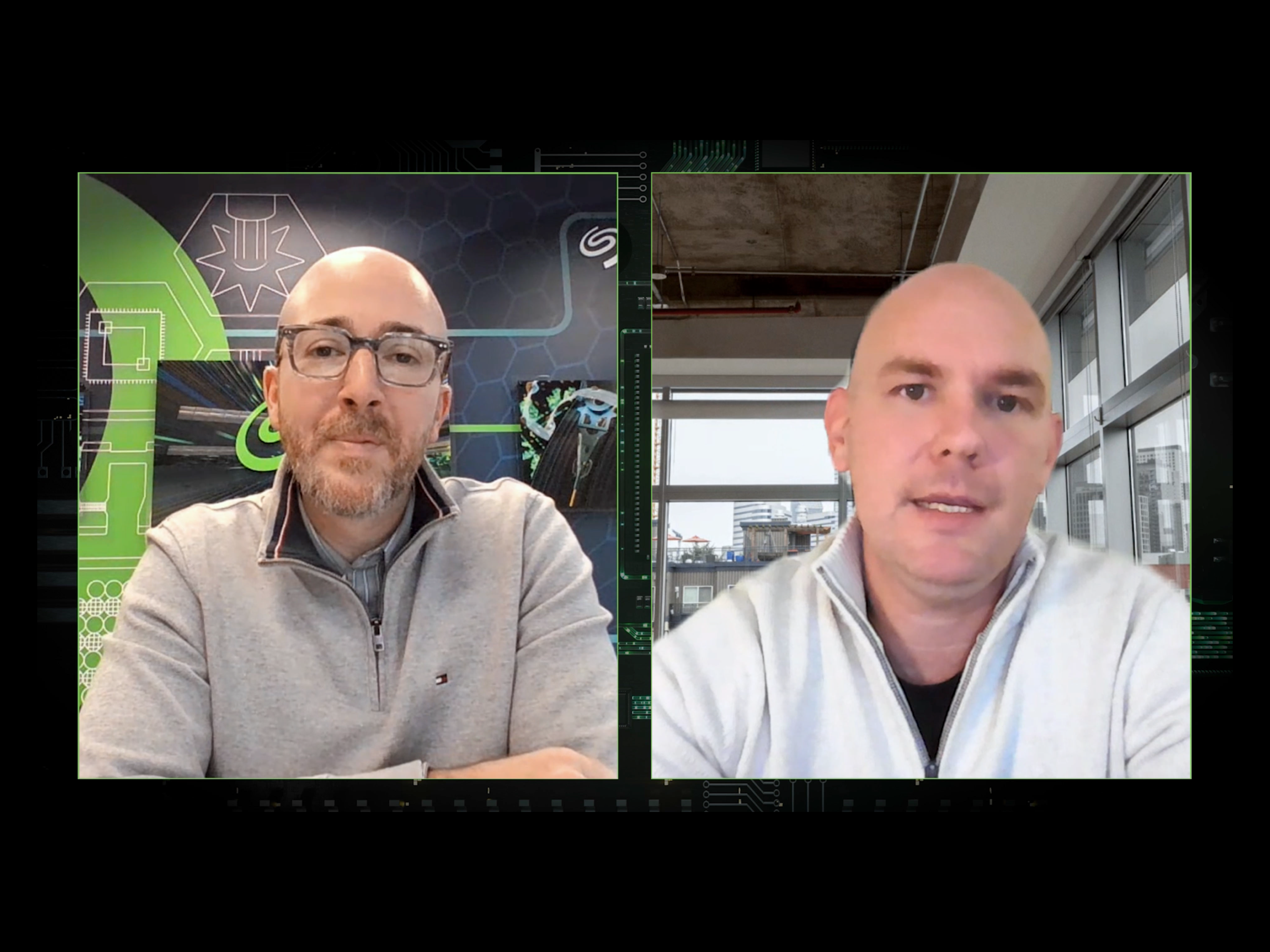
Paul: Welcome to The Data Movement. I’m Paul from Seagate, and on this episode, I’m talking to Andy Edwards and Dave Helmly from Adobe about the future of video editing workflows. Let’s get into it
Dave, Andy, so good to have you guys here on the show. It’s such an iconic brand, first of all. You guys have been with the company for so long, and so many cool stories to uncover from the pair of you and excited to dig into that. But Dave, I’m going to start with you.
Dave: Yeah.
Paul: 30 years.
Dave: 30 plus years. Been there a while, so,
Paul: That’s been a
Dave: A nice run...
Paul: a wild journey as well, right?
Dave: Yeah. Been amazing.
Paul: What are you seeing today in terms of how things are playing out that are having impact?
Dave: I think it’s a good question. I mean, obviously AI. I’m sure we’ll dig into that a bit on the chat today. You know, for me, it’s just another thing. Like, I’ve seen it. We launched Photoshop and we had people very concerned about photographers… very concerned about certain aspects of the business, and things that would go away, the dumbing down of business, things like that.
We’re seeing a lot of that on AI, and it’s just, an education process to help people get through the next technology. But if I just look back at the last 30 years, I’ve seen a lot of this repeating itself, technology just repeating itself… these changes. And a lot of times, there’s a lot of change for good.
Paul: Right. When you look back, what are some of those moments during your career where there’s this big thing that’s happening that feels seismic and feels like things are getting shaken up. Can you point to some of those?
Dave: I think one common thing for a lot of these changes… So, obviously we had the first one was print, so PostScript, right? You go way back to Adobe. There were printers. There were places you went to go get things printed. There was a whole process. We made that way more accessible. Really, just the tools changed, right? We got into photography, as I said. We didn’t really need film once we got to digital.
But there was also an evolution that happened because the pixel density and the dots per inch on print wasn’t quite there, and anybody who was skilled with 10,000 hours would look at that and go, “That looks terrible,” and “it’s not even good for a church missalette” or something.
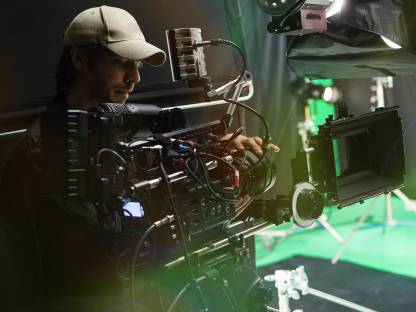
They would be like, “We know we really need to have high quality.” It got there. We saw that in cameras and photography with sensors and all that. Even looking at, your little mini studio here at NAB today, who thought you could be shooting on three DSLRs that are absolutely top quality with top quality lenses?
There was a time when that would not have been seen, and I go back and look at AI and a lot of this, and just think about it’s just another loop.
Paul: How do you guys think about it? Do you see it as a huge creative opportunity?
Andy: Oh, absolutely. It’s change. As somebody that’s been in broadcast for over 30 years, and the iteration that we go through for the camera cycles, the computer cycles, your products. I’ve been a user of your products where I traded a UVW 1800 deck for two 9 GB Seagate BarraCuda drives because it needed to match my NLE system. And the growth and the constant feed of that into the data stream that you’re having to do with those drives, you’re always looking to grow that.
So, from a broadcast perspective, I’ve seen it change, and AI is just going to make things simpler for some parts of it. And being creative… you’re going to be able to do a lot more with that.
Paul: This company that sits at the intersection of data and technology, and creativity, and you guys get to play in that intersection and look at what’s ahead.
Dave: Yeah, I would agree. But a lot of it, we have to go back. We talked about Adobe being an iconic brand. I mean, Seagate, come on, right? Right there with Adobe. Probably been there every step of the way, if you really think about it. The changes that we see around the creative tool process… it’s all about the partners.
We can’t do it all, right? So we need those technology partners to come in. We even need software partners to come in to make our software better. So to create this ecosystem that we see here at the trade show today and even other trade shows, it is really a community of people, a collective of people that come together to build a better toolset for the creator. I think that’s a large part of what makes this possible.
Andy: I mean, partnering with all of our partners every time… my customers, they might use different brands, but ours is at the core, maybe. We’re just going in and we’re like, “Okay, we’re going to talk to our partners. We’re going to solve this problem for you,” because they’re using a lot of different products of ours.
And just having that relationship is important with your brand, from a storage perspective, and it’s great.
Paul: What I’ve always admired about Adobe is just how close you are to the customer. Everything that you guys do feels customer centric. And one of the things that has always inspired me, is from that customer centricity, you’re plugged in to what the customer needs and the democratization of creativity to a large extent has been driven by companies like Adobe, right?
Dave: Yeah. Totally.
Paul: So what are you seeing from customers? What are they asking for that is making you think about the future?
Dave: Yeah. I think the first thing to recognize, and you talking about jobs and finding all that, we are a pretty specialized team at Adobe that we’ve been given the bandwidth.
We work for engineering and part of that team. The partner team that manages relationships like Seagate are also part of our team, so we’re all one group under engineering. We get to go to the customer. This is a non-sales operation, right? Customers trust us.
We can get in there and just say, “Okay, tell us what the tool is not doing.” It ranges from you don’t support this codec or you don’t allow this feature or some sort of translation. Whatever the feature is, we bring those back to engineering just for that touch with the customer.
And then we get to go back when the product either gets updated or a change happens. Or in a lot of cases with Andy, he finds a bug and he gets a bug fixed. We get to go back to that customer and say, “You helped us with that problem.” And we actually make a point to do that. We will go back and say, “Remember the feature you added? We got this feature in there.” I just actually updated a friend of mine here at the show because I got a feature added in the product that he was specifically looking for. So that’s one way I think that we maintain that relationship. And I think Adobe overall as a company wants to hear from customers, in all sorts of forums and things like that. What are your thoughts?
Andy: The key thing for me of doing this role is I love to investigate the problem. I want to dig into it because something happened in their environment and we want to give them the best digital experience of our products we can, and that’s something that’s a challenge. But boy, when you see them – “ I talked to Andy for ten minutes and we’ve solved that problem that’s been a pain point for a while.” That is the joy I get, and then carry that back to our product team and go, “You guys fixed this for this customer that’s been a pain point and they are so happy,” and share it with the team because it’s a joint effort.
Dave: And Andy, to your credit, I would also say something to the fact, and he would often say this, he or she is probably not a one-off. They were just the first one to come forward to manage to talk to Andy, so we probably fixed it for 10,000 people. You never know. So that also is another feel good.
Paul: Video.
Dave: Yeah
Paul: You guys do a lot. You play in the video space. It’s a huge driver of our business and we believe will continue to be.
So let’s talk about video. What are you seeing in the video space that’s driving the future of video content creation?
Dave: I think, not only do we need more… we started out with megabytes to gigabytes, now terabytes. A lot of these cameras, 4K has become just a normal way of shooting because we like lots of room for framing and all the flexibility that you might need, and we’ve obviously got higher than that.
So the data management and the speeds that we need the partners to be able to deliver to give us a real-time experience on the timeline, that’s again just part of the evolution we were just talking about. But data requirements have definitely gone up. And then when we start talking about generative video, we’ve hit on some of this before.
We can allow people to take a video file on a timeline, maybe expand it by two seconds, and have AI sort of come in and fill in the gaps. We can also make new video, if I need a purple squirrel on a green skateboard or whatever it is that I need. That’s new content that didn’t exist, and I need to be able to pull that into my process. And I might need ten of those, and chances are I’m just going to maintain all ten of those for my ideation process or things like that.
Andy: Right. I just see growth. Nothing but growth. The creatives are going to explore things with our products. Give, for example, boards. You can storyboard something so quickly, and you’re just seeing all these different iterations from Firefly, if they’re using our products. And they’re just iterating, and that creates files and files and files.
And having to manage that is going to be the challenge I see in the future.
Paul: What strikes me as interesting about generative AI and its impact on data growth, is when you compare it to traditional video capture, where you’re out in the field shooting with a high-res camera. The impact on the data creation with generative AI feels like the inverse in that you’re starting with a very low-res format.
Paul: But then there’s this multiplying effect as you take it through your tools and the production workflow, and it grows and expands. And you have a great talk track for this.
Dave: There’s a lot to think about there. So, we went up and we said, “We need an image of two people surfing at golden hour.
Paul: This is like an advertising use case
Dave: Exactly. A great point. A 50 millimeter lens on a dolly shot. Now, you can talk to AI that way, or you can make it real simple. So AI will handle that either way. It creates this video, and I’ve got the one that I like, and it creates an MP4 in 4K.
We’re already getting the request to try to see where this is going. As we go through the ideation process, and maybe it took me six to get the one that I wanted, now I need that in a ProRes, right? So either I’m going to flip it on my computer and try to figure that out or – we’re working on this now – to make sure that I can do that when I say I want to commit, make me a ProRes.
Now, on a legality standpoint, because this is always the question, I need you to show me a path of how you got to that asset. So really, none of that process gets thrown away. In many of these use cases, you have to be able to show your work and prove your work. All that could maintain in a folder, in an asset folder somewhere that shows the ideation process was mine.
Then we could also get into just archival. So people are now bringing tapes. We got to get those to archive. We have to do what’s called media intelligence, so I can scan that data and figure out that there are three people in a room talking about whatever. And that’s called vector data.
This media intelligence, that’s even more data that gets put in, and it all started in an archive. Maybe somebody digitized that before, but we’re like, “Okay, I need you to take that old digitized version you have, upscale it to 4K and do media intelligence.” Well, that’s now three separate data files. So this is where I say, storage requirements are not going to go down, right?
They’re only going to go up, and I just need ways to find that data or find even that one clip or that one shot, or that range of shots that are in there, and I need to be able to show where that start and where it began for just content authenticity. Andy, any thoughts?
Andy: Just how you go from a still frame to an HD frame, a 4K frame… that’s just going to be data growth.
And having to manage that, you can do it with our tools … you can do it with other tools. It’s something that you got to get a hold of now because it’s going to continue to get higher.
Dave: You brought up a great point, Andy. You start with a still image. Here I have you sitting in a chair… I take a still image.
Maybe you’re a stock photo, right? And I didn’t get the shot that I needed, and I need you to change the position of your legs, and I just tell AI or make you lean the other way, turn your head and turn it to video. So, now I started with a very small file. I did my AI thing, showing my work, and then —
Paul: You want me drinking water.
Dave: Well, exactly. And by the way, the physics, if you’ve been watching what’s going on, are getting really good. So again, the data requirement from one still picture, right? Maybe all the way up to video.
Paul: When I think of Adobe, I think creativity. Democratization of creativity. How do you guys think about that in relation to the creative process that we just went through?
How do you reconcile? The devil’s advocate is like what you’re describing is actually anti-creativity. How do you guys feel about that?
Dave: 100% and it’s something that we answer questions on every day. And again, this is just part of our culture at Adobe.
We certainly want people to continue to use the tools. AI for good. We want to make sure that the person with the 10,000 hours, as I mentioned before, they know the creative process. They know what looks good. So long as we can make the tools for them to drive it the way they want to do it.
We have a product called Firefly. So that’s not only a website that you can go to and do all the Firefly tools, it’s also an image model, so it’s both. And I use the word Firefly like a verb. So if I’m, if I’m in a product and I’m Firefly-ing, I want to be able to Firefly gen AI by layer.
So that, when I can do that in Photoshop, and we have been talking about doing it, which we will be, talking about this later, bringing this to products like Premiere and After Effects, being able to do generative media by layer puts that creative in the driver’s seat. I’m in full control. AI got me where I needed to go, and if you’ve seen products like Nano Banana inside of Photoshop, I can move things around, I can turn my head this way, I can turn my head that way.
That really is putting that person in control because something just doesn’t look right. Let me use AI to, help me nudge things the way that I would normally nudge things in a product like After Effects or Photoshop.
Andy: And from a brand perspective, we put guardrails into that.
Paul: This is like an enterprise use case, right?
Andy: Yeah. Our foundry models, if we have enterprise use cases where we’ll partner with a customer of ours, and they’ll be like, "We want to train just on our data." They’ll use our foundation model. And they’ll be able to control that their assets are in their possession, and it’s trained on the way that they want it done.
It’s a good thing, because there are other models out there that are just freewheeling, and we want our customers to know that we’re protecting your use of our model.
Dave: Yeah, and with all the changes I just mentioned, with moving things around and all that. One of the things that we should let, your audience should know as well is we have a content authenticity group. And there’s a term that they’ll learn about if they haven’t learned about it yet, called C2PA. And we have a person at Adobe who’s responsible for that.
So some of our partners on the camera manufacturer side want to make sure that when your camera operator here hits that red button, there is no AI from start to finish, and when that gets into a Premiere timeline, you do whatever you need to do to it, and when you export that out, all the content credentials follow through, so when that gets posted somewhere, we know that that content is right.
Or if we did need to move your head from left to right, then I could go in and say, from this frame to this frame, AI was used. And then there’s a judgment, was that used for good – or not? So I think there is a ton of things that we’re doing even on the responsibility side, keep the creative in the creative zone, but yet keep the lawyers happy to know what was going on in that process to protect, the person and the media.
Paul: Andy, I want to go back to something you shared, because you talked about customers training the software on proprietary data.
Andy: On our Foundry model.
Paul: But the thing I was most curious about was the data sets that the Foundry model is trained on is the customer data.
Andy: Yes, and they’re in control of that. And, a certain show, which I can’t say, would bring their assets into it, and they would be able to generate assets from that show.
Paul: So, this is a mainstream show that’s running at the moment?
Dave: Yes. And we have a lot of them.
Paul: Right. Interesting.
Dave: We have animations to where they’ll take their IP. Let’s just say you have a show that has a lot of castles in it and those castles look like they need to look like. And there’s characters and there’s names, animals, whatever that is, and we need those to look like certain things.
I think, Andy, we’re seeing most of this being used for ideation and setting things up. Or we’re starting to see them, be able to fill in quick shots. And again, it all goes back to that data’s got to get stored somewhere. So not only do we have the training data, right, Andy?
Andy: And they’re storyboarding. They’re using it from the creative process. They’re going, “I don’t want to have to draw this every time, but I want it to be correct based on our model that they train.”
Paul: So, the kernel of creativity is human inspired. What you’re describing is just filling in gaps and accelerating certain parts of that workflow.
Andy: And giving them tools to ideate faster and be able to do faster turnaround — and it’s not removing the artist. The artist is the key. They have the vision. The creative is the one that brings that product to life with a group of people and they all ideate with these tools, and it lifts up the whole show.
Dave: And I’ll give you one other thing to think about, just thinking about the size of data in these things that we’re shooting. Here we could be shooting an hour video podcast. Your editor’s now got to get that down to 90 seconds to get people interested in what’s going on, or less, or maybe there’s three minutes.
So we did just release on our web editing platform, an operation we call Quick Cut, but it’s really just a cutdown. Now people would say, “Well, if you can get in there and give it a prompt,” which you can do. You can say, “I want 90 seconds where Dave and Andy get into conflict.”
And it’ll do that. And I want a fast-paced cut to where we’re going back and forth on a rapid fire. But we know that when that rough cut happens or that assisted edit happens, that’s just where the work begins. Your editor now has to go in and L cut, J cut, do the graphics, motion blur… all the things that they need to do.
So one of the popular things we’re seeing at the show is this ability to take hour-long footage, which is great, and be able to auto-assemble it, auto-cut it, get a string out. And I think people are not understanding what it takes, if it’s quality media, to actually get that out.
Andy: Because even though they’ll cut out the pauses between us because they want to save time, well, sometimes I want to see you thinking. I want to see your vision. I want to see or feel your pause. That creative editor should feel that. There should be an ebb and flow of the show.
Dave: And by the way, we’re hitting on a number of topics today. You’ve probably got four mini edits that you could do to say, let’s go back when we talked about the cloud or AI. We haven’t even talked about agentic… all these other things. You could just have a mini cut, and for the editor, you’re just giving them an amazing string out, a way to get started.
So again, our AI for good is keeping that creative in the seat, in control, that 10,000 hours. And I think on the Seagate side, just to throw it out there, you’re now able to shoot longer shows. You don’t have to worry with, “okay, we’ve just shot four hours of media. How am I going to get through that?”
Easy. AI’s going to get you where you need to get, compare it to a script, suggest some B-roll, these types of things. So you’re going to end up with way more media to get a smaller video out, but a video that’s more on point with wherever you’re trying to target, that aspect of the show.
Paul: You mentioned, Dave, earlier the importance of, like, lineage and… I think you said authorship.
Dave: Authenticity.
Paul: Authenticity, lineage and having the system just seems so critical that is able to map all of these assets and that path that the tool is following for authenticity and the lineage to make sure that that is traceable.
Dave: Depending on the audience, and let’s say we’ll just, pick on enterprise. So large organizations, we have a thing called Adobe CAFE. We’ve been talking a lot about it at the show. So it’s Content Authenticity For Enterprise, so CAFE, and those needs of an enterprise are a little different.
I need to know that when we edit this and we put this video together, that this is a Seagate video, and it was edited by Ray, our editor, right? So all of those credentials can be captured. So if that video end up anywhere, and again, content authenticity is more than just saying “was AI used?” There’s lots of different, “Whose property is that?” This is a way to tell where this video came from. Now, we can take it down to the editor level. There’s a lot of, knobs and switches you can turn on in this environment, but I think that’s going to be a big part of it. So was there AI used? Whose property is this?
Again, if it’s property of Seagate. Anybody, by the way, that ends up with a video — maybe they downloaded it somewhere — will be able to drag a video into the contentauthenticity.org site, and it’ll and it’ll come up and tell you everything it knows about that video — assuming it wasn’t altered — and it would say verified or unverified.
There is a blockchain of information that it knows, and that’s only growing by just members joining this. So not only cameramen members, you’ve got news agencies that are all joining this content authenticity.-
Paul: Who’s behind the initiative?
Dave: Adobe’s behind it. You’ve got a lot of the different … Thomson Reuters … the news agencies. A lot of brands are getting behind this thing. Sony’s been a big player on the camera side... I talked about C2PA.
That’s all part of this umbrella. Hit the red button, tell me what’s happened during this process.
So content authenticity, it means a lot of just we understand when and where and how this file came to be. And who touched it to some point.
Paul: You mentioned it earlier, let’s talk about agents. That sounds like it just dials up the notch another level.
Andy, what are your thoughts?
Andy: It’s coming. For us internally, we’ve been playing with this, and it’s something exciting. To be able to take, say, Codex or something, ChatGPT, and use that, and I’ve never really coded in my life. And to spend four hours on a weekend and make a panel for Premiere that will solve a customer problem, and then share that with the team, it just, it was exciting.
I was like, “I made that.”
And it’s something new. And I share it with the team. We make it better, we expand on it, and then we push it out. But it’s changing everything. Agents are going to be in so many products, I see.
Dave: I think just to expand on that, too, for people that aren’t familiar with what agentic is or agents, right? Kind of the same thing. It is as Andy said, it could be ChatGPT, Anthropic. We announced our relationship there, just this past week. And what does that really mean to the creator? There are two paths we’re taking that we’re talking about in the booth.
Imagine that I don’t know Premiere as well. I don’t have Andy on call all the time that he’s sitting next to me. It’s going to allow me to talk to the application. Can you set me up a timeline with eight mono tracks? I’ve got to make all my RED media red, make my Arri media green. You can set it up, and I need time markers to go out, analyze this. Tell me everywhere we clapped our hands for a check. So just talking to it, it’ll set up a project. And at the same time, agents will be able to help you quick cut, and be able to say, give me a fast pace, give me some graphics, do this. So the creator is just talking to the application.
But they’re still in control in that creative seat. So agents are just another way to interact with the application. And, we’re fast-tracking a lot of this at Adobe. As Andy said, we’ve got it working internally now. There’s another thing called MCPs. We’ve got this wired up to things like Cursor.
I think this time next year, your heads are going to spin when you see what the apps are doing. But at the same time, they’re the apps that you know and love. Because people don’t want another app that’s limited … that’s maybe cloud based. I want to go back to the desktop.
Andy: And stay within their ecosystem that they’re familiar with.
Paul: So there’s a singular agent or just different specialized agents?
Dave: No, so agents call on other agents. Great point. So this is one AI calling on another AI that can do that job better, and it’s up to the AI to try to figure out, oh, for this function, I need to go talk to this AI agent.
So they’re all working together, but you — the creator — don’t really need to know any of that
Paul: You’re interfacing with the Adobe agent and in the back end –
Dave: And we’ve got it creating, just sort of in the labs experimenting. We’ve got it creating storyboards for us. I can go in there and say, “I want to pick this actor and I want to put him in a TV show that I know,” and it’ll just do it.
And it actually goes to Google and finds the actor. I don’t have to go grab a picture and drag it in there. It’ll confirm and say, “Is this who you’re talking about?” I go, “Yep, that’s who I’m talking about. Put him in this situation. Put him with pink tennis shoes on,” — whatever it is, and it just starts building out.
Then I can say, “Read this script,” and it just starts building out a storyboard. There’s lots of tools that do this on the web today, so if you haven’t seen this, you can go out and have a great time. There’s products like LTX Studio and a bunch of them that have been doing this for a while, which is awesome.
But imagine that inside your application at the time you need it. So, I want to Firefly — my verb — and do these AI edits at the time I need it, when I need it. I don’t have to stop what I’m doing, go out to a website. I want to Firefly right on the timeline when I need it, if I need to upres or if I need to create these assets or any of these things.
So, this is, I think as Andy said, it’s a new toy. These agents are giving us this ability, to create all this new content. And as we’ve been talking about on the show, the need to have more storage, and I need to be able to find that stuff because I need to be able to see where did all this go. I want to go back to those items that I created yesterday, right?
So these are items that I need to retain.
Paul: What are you most excited about? Andy, what’s next?
Andy: Just where we’re going to go with this is going to give such a wide perspective or cast a wide net, shall I say, for all of our customers to help improve our products, but also improve for them.
They’re going to have a lot of choices in the future, and I’m excited by it. As I said, just coding at home on a weekend to make something out of nothing and see it. That was the change for me in the last couple of weeks where I was like, "I can do this now." I don’t have to go to university for six years and train and do two degrees just to learn that.
Trust but verify. Do what you can to make sure you’re iterating safely.
Dave: And I would say for me, we just talked about it. Agentic to me, these agents are the most exciting things. Andy and I will get together several times a day sometimes trying to identify a problem.
I will put most of the credit to Andy. Andy having access to these agents to help me identify the problem. “Here’s all the datasets. There’s this codec, there’s this thing. This is the thing that’s popping up. I just can’t figure out where this issue might be.” And it’s not a matter of just looking at code, it’s a matter of there’s some process, right?
That we’re missing, some variable. Agents are going to, even just make your job a little bit easier to help where is that
Andy: They go in and you’ll do a sample, and you’ll just be able to say, "I think it’s this because based upon experience that I’ve had," but then it’ll propose something. Then I’ll take that to engineering and share, and they’ll be like, "Oh, you’re correct. That was a great assessment, and we’re seeing that now in these files." And so having that tool and analysis as a partner That you can just use on a daily or weekly basis.
Dave: And everything’s a data set now. Just to think about even the future of the company you work for, like, the data sets, the agents have to go out and, knowledge is now data, right?
Knowledge is power, as people used to say. Well, the power is in the data, and you have to retain that because we need to be able to get, to get smarter, to make better decisions. Pretty exciting.
Paul: Very, very cool. If I’m a creative person listening to this episode, either professionally or personally, what advice would you give in the midst of all of these changes?
Dave: I would say learn AI. Be, be in the driver’s seat. Don’t be scared. Hollywood’s not using a whole lot of, saws and hammers these days building sets, right? We’re seeing them be virtual. And seeing what people are able to do in virtual, we thought we’d never see as quick as that. So, I think AI, being in the driver’s seat, you do not have to lose your creative process. Be in that driver’s seat.
Andy: Explore. Try things. See what’s out there. You might find something that improves one little part of your workflow and changes your day.
So don’t be afraid of these tools. Try and understand them and use them for good, and improve your workflow.
Dave: We need the creator to keep being creative, because everyone’s going to have newer ideas than what AI is going to be able to generate. AI is looking at old stuff. It’s not really leaning forward.
So being able to look at what that can do, we don’t want everything to look the same. We want new stories... not old stories. And the younger creatives coming into this learning from the creators that have their 10, 20,000 hours coming in, AI is going to help bring a lot of that together if you take the driver’s seat.
And Adobe is committed to keeping them in that driver’s seat, in that creative zone.
Paul: And you mentioned earlier that you can’t mention the name of the show, but there are shows running at the moment on streaming platforms. I presume, that have been influenced, impacted in some way by, Adobe or more generically, AI tools.
Dave: We have a TV show right now that the lawyers were... It was pretty funny. I remember some of the conversations. “I don’t necessarily have a recent picture of Noah’s Ark,” right? So those types of things, or Ancient Aliens or whatever it is, these types of shows that we need to be able to create an asset or we need to be able to animate an old photo that was never a video to begin with.
That’s pretty interesting to watch some of those things come to life, and there’s a lot of that we’re seeing on TV in what I call final pixel as a deliverable. So that happened a lot faster than I thought it would. Because people, I think, are starting to accept it.
Paul: Nice. Guys, you up for a lightning round?
Dave: Sure.
Paul: All right, let’s do it, and then we’ll wrap. Start with you, Andy. Biggest misconception creative teams have about AI workflows today?
Andy: Scared to iterate maybe, but they’re also under constraints by legal. So there are things that they need to explore to see if they can add these tools to their workflow because it will help them.
Paul: Nice. And Dave, which part of the video pipeline is the most under-engineered for the amount of data it handles?
Dave: So, under-engineered for the amount of data that it handles. A lot of what we’re dealing with... My brain goes right to 8K, 12K, 16K video. We’re obviously here in Vegas coming back from the Sphere. We know a lot of that workflow. That’s a lot of data. And being able to read that stuff on a timeline and being able to play that stuff on a timeline in real time takes a lot, and it takes a lot from the partners not only to deliver the data and the speeds that I needed but to decode that on a timeline so I can actually see that in a monitor in a usable way.
Paul: Good one. Nice. Andy, what’s the most important skill for today’s creators and editors to develop?
Andy: Hmm. Explore is back to my core thing from the creative side. Don’t be afraid to experiment. Use your curiosity. I had a customer come into the booth and say, “I want to be a social media influencer. I want to do this.” Just taking time to explore what your avenues are, what our software can help you with is something. If you’re going to try and please everybody, you’re not going to please your heart. So, follow your heart, go after it, explore, put in the hours, put in the work, and don’t be afraid to fail because when you fail, you learn.
Paul: Nice... Good one.
Andy: In a good way.
Paul: Right. The most common points of failure in a – building on the failing theme – the most common points of failure in a video production pipeline?
Dave: I think not really understanding what your deliverable is. Like, what is the audience? We have a lot of people that will create an amazing piece of video and not output it correctly for HDR for broadcast.
Because what broadcast needs for those requirements are different than what YouTube needs. While YouTube probably is the largest avenue to consume media, there’s just a lot of things in the pipeline where that workflow and those colors are not going to look right. We see a lot of that at the show for the people that kind of know it.
And that’s just one example, but understand where is the final destination of the thing that, that, that you’re creating. That’s a big failure. Audio channels as I just mentioned, color, those types of things. Another one is, a point of failure is when you’re looking at your workflow, take the time to learn what the tools can do. Because if you have a requirement for subtitles and you’ve done the subtitles, you’re trying to expand your brand – thinking about your influencer here – we have tools that will take that to 18 different languages at no additional cost to you, so now you’re making your market bigger.
So, from just failing on the timeline on the output, but also not thinking about where could this go and how big could my audience be. There’s a lot of things that we have in the tool to help you with that. So I’d say a little bit of failing of just not really digging in and learning what’s, what’s there.
Paul: Nice. Last question. This is a big one. What do you think the biggest change in the media and entertainment industry will be ten years from now?
Andy: We’ll be broadcasting from Mars.
Dave: That’s funny too. I just met with the NASA Artemis team before I got here. That’s hilarious that you two even said that. I think ten years from now, I think AI, much like people accept Photoshop ten years later. And I’m really looking forward to this, just that creative process.
I look forward to what is actually happening with media, how media is created. So much automation, but also how is it going to be different? Because I don’t want everything to look the same.
How much control does the individual actually have ten years from now? I think they’re going to have a lot, and people that grew up with digital watches and I remember when there wasn’t cell phones. I remember we had bag phones in our cars was the first thing we were carrying around with us. Ten years later for this, it’s going to be amazing, and I think a lot of it, as we had talked about, is going to be agentic.
We are just going to talk to applications no matter where it is. Maybe we’re wearing them. We’re wearing glasses and shooting video, and we’re editing video and getting things out, but I want to be the one that’s in control.
Paul: I heard somebody say, “Have my agents talk to your agents,” and you figure it out.
Dave: Yes. That’s the theme of the show.
Paul: David, Andy, I appreciate you so much. For sure. This has been a great conversation. I love talking to you guys every time I get a chance. You guys are always thinking big, and it’s inspiring. I learned a ton today, so appreciate the time.
Dave: Thanks for being such a great partner.
Paul: Yeah, great.
Dave: Thanks.
Paul: Cheers.
Dave: Cheers.
Paul: That’s it for this episode of The Data Movement. Thanks for listening. Find us wherever you listen to your podcasts for more conversations about how data is moving the world forward.









.png/_jcr_content/renditions/1-1-medium-416x416.png)
.png/_jcr_content/renditions/1-1-medium-416x416.png)