Products
Knowledge Base
Support Downloads
Articles
suggested searches


You're just [0] away from FREE shipping!
Your cart
You're just [0] away from FREE shipping!
Your cart
Table of Contents

In the data economy, companies continuously face multiple challenges that impact success. One important requirement—and obstacle—for growth is the amount of data your company generates and then stores. Another top-of-mind issue is the expectation that businesses perform in the most environmentally sustainable way possible. Addressing these crucial concerns simultaneously can be demanding.
In the past, when more data storage was needed, it was easy to justify adding more storage hardware to the data center without much concern for the technology inside. This usually occurred before a company established a sustainability strategy or had given much thought to resource consumption, mineral/element usage, recycling feasibility, anticipated maintenance, and other efficiency and sustainability goals.
Today, companies no longer need to accommodate data growth at the expense of sustainability and efficiency efforts. Seagate is helping customers meet both challenges head-on.
Heat-assisted magnetic recording (HAMR) is a technology that improves areal density per disk, resulting in more data to be stored per disk., Traditional hard drive technology increases the amount of disks to improve data capacity.
What is HAMR? For a complete overview of this next generation of enterprise hardware capacity, check out www.seagate.com/innovation/hamr.
But the short definition is in order to fit more data bits onto a single disk platter, the density between those bits must increase. However, with legacy disk platter materials, placing the bits too close can cause unwanted magnetic behavior, affecting their thermal stability (their tendency to “stay put” as intended rather than fluctuate unintentionally).
Seagate engineers devised new platter materials to ensure thermal stability but still needed a way to intentionally alter the data bits in their newer, more thermally stable, environment.
Seagate HAMR implementation involves a small laser diode on each recording head that heats a spot on the disk for a fraction of a second, so the recording head flips the magnetic polarity of a single data bit, thereby writing the data. The heating and cooling of each bit happens within a nanosecond. The laser doesn’t affect drive temperature or stability, or the media reliability.
During research and development of HAMR-based solutions, Seagate engineers remained steadfast about one requirement: retain the existing form factor of the current rack-mounted data storage solutions, utilizing the same 10-disk/20-head setup while increasing individual platter areal density. Initially, Seagate will introduce a 32-terabyte unit based on the same number of disks and heads used in the current 20-terabyte PMR unit (10 and 20, respectively). The next planned product will be 36 –terabytes with the same form factor, followed by a 40 –terabyte version and plans for a 50-terabyte—all based on 10 disks and 20 heads.
So, what do heat-assisted magnetic recording and increased areal density have to do with meeting sustainability goals? A lot, once you start to add things up.
Seagate developed its new HAMR-based solutions to help customers anticipate the vast increase in data generation (and the storage required to hold it). By retaining the same number of disks and heads (the familiar hardware form factor in the data center) while increasing areal density per platter, we can move data storage in the right direction. Perception in this area needs to shift from ‘capacity per drive’ to ‘capacity per disk.’
Some more traditional hard drive technologies will add additional platters into the same hard drive enclosure to reach the higher data volumes, but this approach has concerns. Adding more platters into the chassis doesn’t address total cost of ownership relative to scaling up.
The image below demonstrates how three data centers equipped with HAMR technology can contain an equal or higher amount of exabytes of data compared to four data centers using traditional PMR drives. That’s as much (if not more) data storage within one less data center, which can cost hundreds of millions to low billions of dollars to construct and equip, and tens of millions of dollars more annually to keep it powered up.
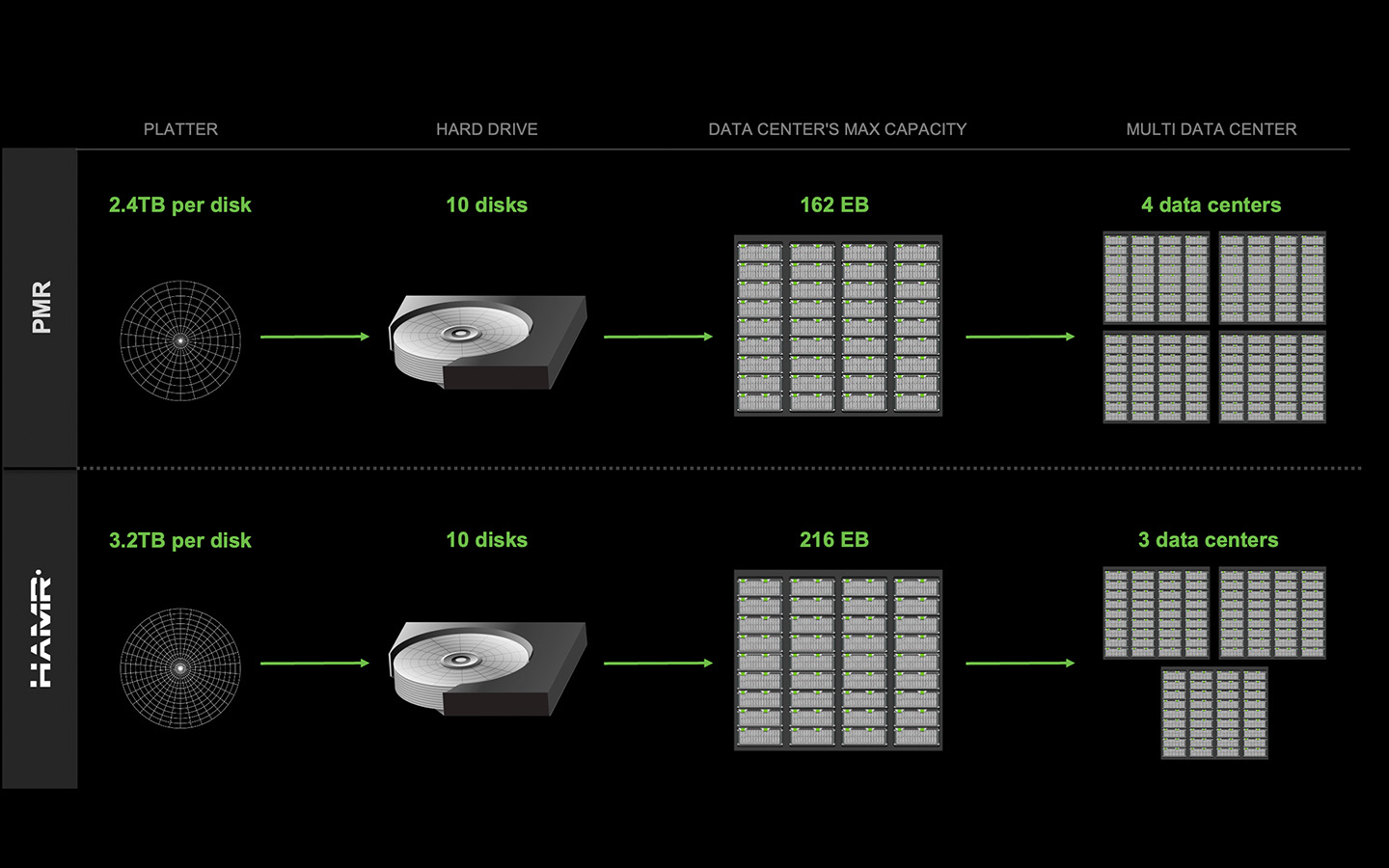
Seagate HAMR-based hard drives allow us to offer products designed with 10 discs (or even less), enabling the lowest cost per terabyte, the highest terabyte per square foot, and the most terabytes per watt.
Facing increasing data storage requirements with current hard drive technology means data center managers would be forced to add either larger sized storage hardware (increasing rack ‘U’ size) or more units of the same size. That decision could lead to more costs, including an increased number of physical racks and additional data center floor space, resource consumption and distribution, overall maintenance, and more.
In addition to aiding customer sustainability strategies, Seagate initiated its HAMR solutions plan in accordance with its own global citizenship goals.
For example, Seagate HAMR-based hard drives will include 95% similar technology as existing Seagate legacy technology hard drives, utilizing a large amount of pre-existing build materials. Seagate HAMR-based products will also follow the company’s edict to adhere to responsible sourcing of minerals, such as tin, tantalum, tungsten, and gold (known as 3TG), and cobalt. For a thorough explanation of this company goal, see https://www.seagate.com/global-citizenship/responsible-sourcing-of-minerals.
Once added to Seagate’s wide range of data storage solutions, the new HAMR-based hard drive products will also be a part of the company’s product life cycle assessments (https://www.seagate.com/esg/planet/product-sustainability/#partners-tabContent--0). As part of these evaluations, Seagate publishes a sustainability report for each product that covers multiple environmental factors, including energy and greenhouse gases, safer materials, scarce resources, and materials efficiency and circularity.
For customers who understand their data storage needs will only continue to grow, it makes sense from both a TCO and sustainability perspective to fully consider Seagate’s areal density improvements and imminent HAMR-integrated solutions.